The Swift telescope, launched in 2004, is now falling toward Earth’s atmosphere, and the spacecraft sent to rescue it has run into its own problem.
Katalyst Space Technologies said its Link satellite is experiencing thruster problems and has gone into an uncontrollable spin that is disrupting communication.
Recent solar activity caused the Swift telescope to descend faster than expected, and it needs a lift as soon as possible to get it back into orbit and continue scanning the universe for explosions and gamma-ray bursts. Without help, the Swift telescope is in danger of burning up in Earth’s atmosphere.
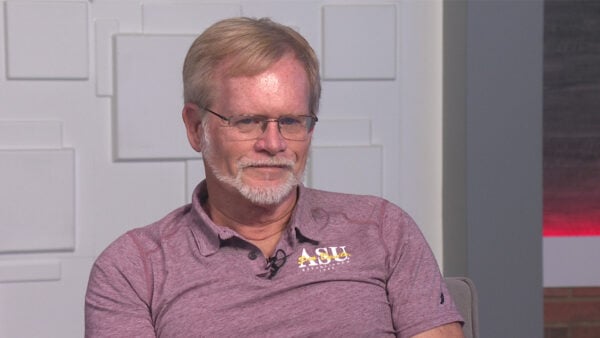
Rolf Jansen, Research Scientist for Extragalactic Astronomy and Cosmology, joined “Arizona Horizon” to discuss the next step in the efforts to save the Swift telescope and what could be at risk if the mission fails.
“The Swift telescope was built for a two-year mission and has lasted for 21 years,” he said. “It’s a marvelous success story.”
Unlike other spacecraft, Swift does not have a propulsion system, and with a surge in solar activity expanding the atmosphere, increased drag has pulled the telescope closer to Earth, getting faster by the day.
The mission aims to dock Katalyst’s Link spacecraft with Swift using robotic arms. Once attached, the vehicle would use ion thrusters to raise its orbit by about 50 miles, potentially extending its mission by another decade.
However, the rescue spacecraft suffered its own setback during its mission.
“They experienced some event. We don’t know what,” Jansen said. “It sent this little spacecraft tumbling.”
Although engineers regained communication after it automatically reset, two of its three reaction wheels are no longer operational.
Despite the malfunction, Jansen said there is hope because the spacecraft generates enough power through its solar panels for engineers to work on a solution.
If the mission succeeds, Jansen said it could transform how satellites are maintained in orbit.
“It could be a game changer.”