Chandler high school students are finalists in international math competition
April 23
A team of four talented students from a Chandler high school are finalists in a prestigious international math competition.
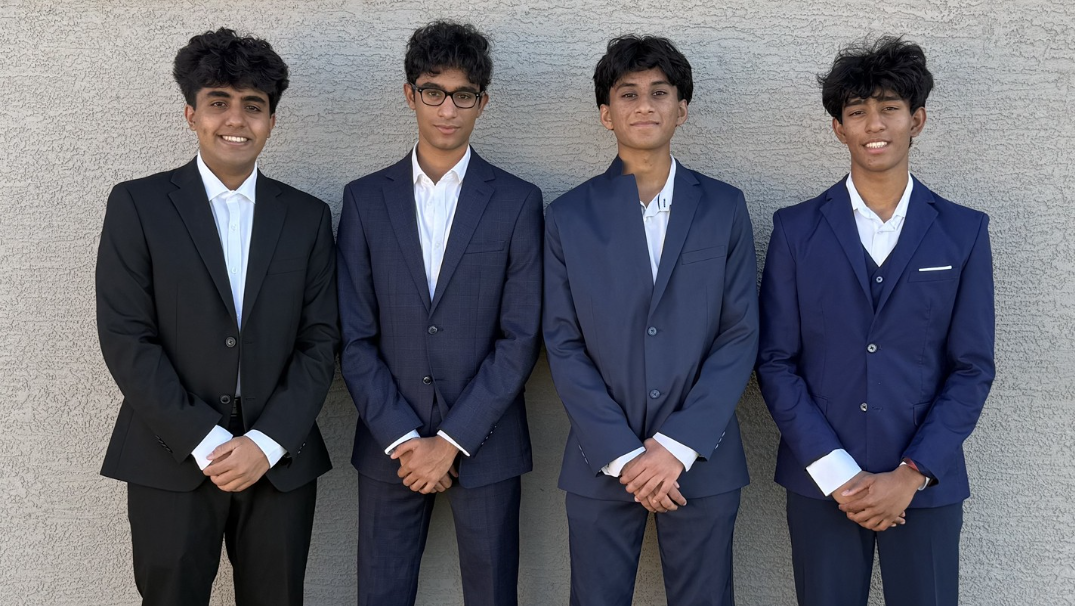
Arizona College Prep high school students, Vishnu Tailor, Rishi Malatkar, Akil Gopinath, and Varun Sunku are one team of nine finalist groups, who will head to New York City on April 27 to compete in the final round of the competition.
The students learned about the online competition and decided to challenge themselves. The students worked around the clock for 14 hours to come up with mathematical models to solve real-world questions: Should we be concerned as a society about the growth in online sports gambling? How much total money is being lost to sports gambling in the U.S. and U.K. yearly? How much is too much for an individual to spend on online sports gambling?
Tailor and Malatkar, who are both seniors, said they learned a lot from the experience. The students were up against some of the top high schools in the country and in the U.K. and weren’t sure they would even place in the competition.
“We were kind of surprised because obviously this is a really prestigious math competition for us,” Tailor said.
The MathWorks Math Modeling Challenge, also known as the M3 Challenge is an online competition for junior and senior high school students. In March, more than 3,400 students competed for a top spot, where teams can earn a pot of $100,000 in scholarship money. The champion team receives $20,000.
The M3 Challenge is in its 21st year and is part of the Society for Industrial and Applied Mathematics (SIAM), which is sponsored by Mathworks. SIAM is a group of math academic professionals from all over the world who use applied mathematics to merge science and technology and apply them to real-world problems.
“It’s always something that I’ve enjoyed doing and then this is just kind of taking all those math skills that we’ve learned over the years and just applying it to this kind of real world scenario like gambling and stuff, which was pretty cool to learn about,” Malatkar said.
Jonathan Thompson is a chemistry and mathematics teacher at Arizona College Prep and helped coach the students.
“M3 Challenge gave these students a chance to experience mathematics the way it is often used outside the classroom. They had to analyze uncertainty, defend their reasoning, and work as a team under pressure,” Thompson said in a press release.
How did Chandler students use math to find solutions to real-world issues?
The students came up with creative and innovative strategies to devise a mathematical model to answer the questions. Malatkar shared how he came up with the solution to answer the first question: Should we be concerned as a society about the growth in online sports gambling?
“I developed a model that would take a person’s geographic area, their salary, their household size, their healthcare cost, their social security. I would take their salary and from that I would subtract everything like all these transportation costs, housing costs,” Malatkar said.
Malatkar then created a math model on how much disposable income a person would have to gamble depending on a person’s salary.
Tailor tackled the third question on the issue, which was: How much is too much for an individual to spend on online sports gambling?
“I had to translate all the data, all the models we found (into) something people could actually understand with another model actually, which is in our paper. So, it wasn’t just about doing math. It was about using math to understand a real issue in a practical way,” Tailor said.
What did Chandler students gain from the math competition?
Through researching and participating in the competition, Tailor and Malatkar were surprised at how much of an impact gambling could have on a person’s income.
“Doing the exact math, realizing how much money, how big the difference is when you take the money that people (gamble),” Malatkar said. “The average amount of money spent on gambling compared to putting that money in like a savings account like maybe even a retirement account like a Roth IRA. Having that quantified in numbers really made it a lot more apparent to us,” he added.
As a teacher, Thompson said he notices more and more young people gambling.
“I imagine that’s why they put these questions forward to kind of help curb that future of gambling because they can get out of hand as the data shows,” Thompson said.
Malatkar and Tailor said there are other world issues that math concepts could be applied too and help address.
Malatkar shared some ideas on issues he’d like to see dealt with in Arizona such as building better infrastructure to tackle heat issues.
“One thing that I think math could be really useful for us (is) creating more heat resilient buildings that can harness solar energy. (And) insulating the buildings to prevent less money spent on things like air conditioning,” Malatkar said.
“I think math could play a pretty important role in something like that.”

Reporting by “Arizona Horizon” Education Solutions Reporter Roxanne De La Rosa. Her role is made possible through grant funding from the Arizona Local News Foundation’s Arizona Community Collaborative Fund and Report for America.