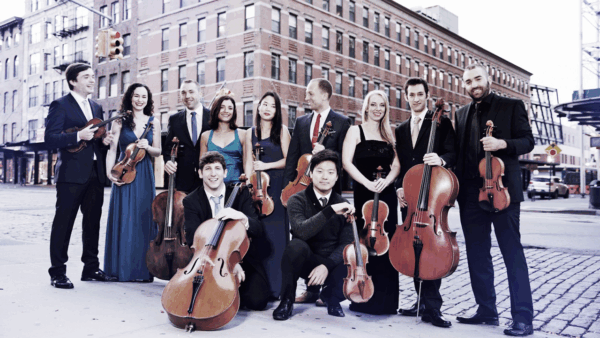
In any ensemble, there are instruments you notice immediately – like the violin soaring at the top, or the bass anchoring everything below. But somewhere in the middle, holding it all together, are the voices that feel closest to the way we actually speak: the viola, the bassoon, the trombone, the euphonium. This program spotlights all four, in music written to let these often-overlooked instruments finally take center stage.
The program opens with the world premiere performance of Chrysos by Jenni Brandon – a composer whose catalog of over 100 works appears on required repertoire lists at institutions like Juilliard and the Manhattan School of Music – performed by bassoonist Albie Micklich and pianist Andrew Campbell at ASU’s Katzin Concert Hall in February 2024. The piece follows the life cycle of the Monarch Butterfly across five sections, with the bassoon carrying the journey from egg to caterpillar to final emergence. Hope Salmonson’s Vita in motu follows, performed by euphoniumist Alex Avila and pianist Andria Fennig at the 2023 International Tuba Euphonium Association Conference at ASU. The title comes from a sundial motto at Houghton Hall in Norfolk, England – “life is in motion” – and the piece moves exactly that way: lyrical and unhurried in a cyclical way.
The second half of the broadcast turns to the trombone and viola. Barbara York’s A Caged Bird, performed by trombonist Brad Edwards and pianist Gail Novak, draws on the tradition of both Maya Angelou and Paul Dunbar while broadening the concept of “cagedness” to encompass gender, sexuality, economic circumstance, and physical limitation – any of the boundaries from which we struggle toward full human expression. The broadcast closes with violist Molly Gebrian’s arrangement of Dame Ethel Smyth’s Cello Sonata in A minor, performed with pianist Danny Holt. Smyth was one of the most important British composers bridging the 19th and 20th centuries, and her 1887 sonata moves from a brooding Romantic opening to a fizzing tarantella finale. Gebrian, who holds degrees in both music and neuroscience and joined the faculty at New England Conservatory in 2024, has dedicated her performing life to championing music by underrepresented composers – and this arrangement brings Smyth’s music squarely into the middle-voice world of tonight’s program.
Featured in this episode:
Brandon – Chrysos – Albie Micklich, bassoon; Andrew Campbell, piano
Salmonson – Vita in motu – Alex Avila, euphonium; Andria Fennig, piano
York – A Caged Bird – Brad Edwards, trombone; Gail Novak, piano
Smyth (transcribed by Molly Gebrian) – Sonata in A Minor, Op. 5 – Molly Gebrian, viola; Danny Hot, piano
- excerpt only