ASU researches immunity in Ethiopian monkeys to understand human viruses
Jan. 28
More from this showAs seen amongst young children throughout day cares and schools, if one child gets a cold or flu, suddenly the entire class has it. This same patten has been spotted in the highlands of Ethiopia within a community of wild monkeys.
ASU researchers set out to study baby gelada monkeys and noticed adenovirus infections were most common in babies younger than 6 months who spend more time with their moms, rather than playing.
Researchers have surmised that gelada babies pick up the virus through socialization as they ride on the backs of their moms, who mingle with other monkeys.
Understanding the immunity of wild primates allows researchers to see the evolutionary and ecological origins of the human immune system. Humans share many biological features with other primates, although they live shorter lives and mature faster.
Due to these shared features, scientists are able to observe how viruses emerge, spread and resolve over a short time frame.
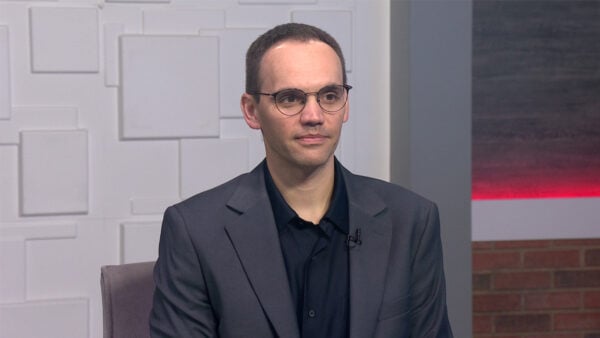
India Schneider-Crease, the Assistant Professor at the School of Human Evolution & Social Change at Arizona State University, joined “Arizona Horizon” to discuss how these studies can help researchers understand viruses in humans.
“Gelada’s, in my personal opinion, are the best monkey species,” Schneider-Crease said, “…they look like baboons, they are related to baboons, but they really diverged for millions of years…they are one of the only primate species that is adapted to high altitudes.
The Gelada species comes from Ethiopia, as the males generally weigh roughly 22 KG, and the females roughly a bit less than 22 KG.
“For this study we were really interested in looking at how viruses behave over the course of the host development,” Schneider-Crease said, “…so really understanding what kind of factors play into the acquisition and distribution of these viruses when we have a lot of infants that haven’t developed immunity yet.”
Schneider-Crease explained that studying viral acquisition in human infants is a lot harder, and can be really practically, and ethically difficult to do.
“We can really examine what’s going on,” Schneider-Crease said, “…they (Gelada’s) live closer to the lives that humans had over the course of our evolution.”