How do planets work on the inside? One Arizona State University researcher is trying to find out.
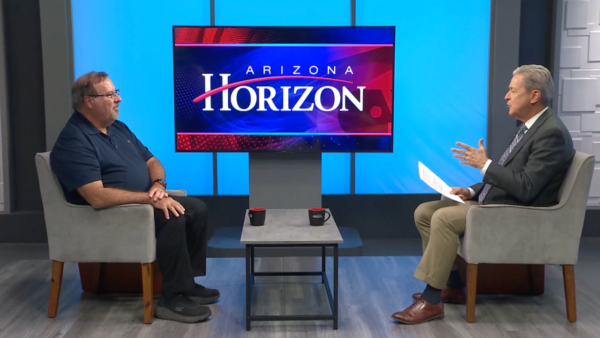
Sibo Chen, an assistant professor at ASU’s School of Molecular Sciences and at the School of Earth and Space Exploration, joined “Arizona Horizon” to discuss the Facility for Open Research in a Compressed Environment’s lab’s work.
Chen re-creates the extreme interiors of planets in ASU’s FORCE Lab. High-pressure instruments are used in the lab to mimic environments below the Earth’s surface. They also help investigate the presence of water and hydrogen on Earth and Mars. He is learning more about how worlds evolve and remain habitable.
Researchers are also recreating the extreme conditions that can be found deep inside planets using a two-story-tall, 6,000-ton uniaxial multi-anvil press called the Ichiban.
“When you look deep into the interior, the environment is so different from what we have on the surface,” Chen said, “…the temperature is very high, the pressure is also very high.”
Chen explained how crucial the new ASU lab has been to their studies. They conduct their research by squeezing samples using tasks and other pressure mediums to generate high pressure, and using electrical currents to generate high temperature.
“What we’re doing is not just inside the Earth. We also have some research inside Mars,” Chen discussed, “…Mars surface is pretty dry, but there was a lot of evidence showing there was some liquid water on the master surface before, but why did they just go?”
According to Chen, their team is looking to uncover why Earth still has so much liquid water on its surface, and if Earth’s environment resembles Mars in the future.
“Some research just shows the environment even in history, so those two planets have quite similar environments or evolutionary passes, which are very close to each other,” Chen said, “…so this is why people are saying this is a sister planet.”