For years, many scientists believed that early human hunter-gatherer societies were largely equal, with little to no leadership or hierarchy. Many strong inequalities we see today appear later with farming and complex societies. However, new research out of Arizona State University contradicts that belief.
Psychological research and ethnographic studies suggest that inequality in influence, who people follow and listen to, may have been part of human societies deep in our evolutionary past. The findings suggest that leaders were not chosen by aggression, strength, prestige, or fighting ability.
Leaders rose to the top because others felt they were knowledgeable, skilled, successful, and trustworthy. This research may help understand the path to leadership and how to better interact with each other.
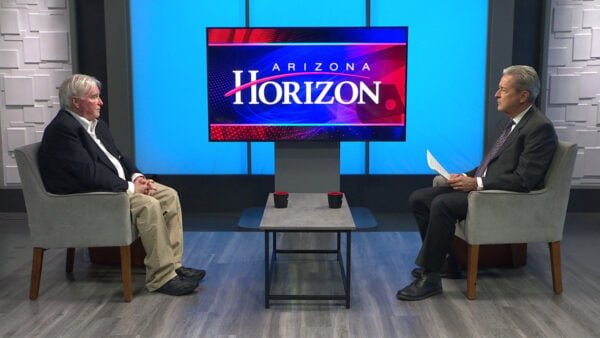
Dr. Thomas Morgan, Evolutionary Anthropologist at Arizona State University, joined “Arizona Horizon” to discuss more about the research and what the findings mean.
“If you look at almost any species, there are some individuals that have more influence, higher status, more access to resources,” Dr. Morgan said, “…these are very different from the sorts of hierarchies that we might see in our society today.”
Many anthropologists and archaeologists found very limited evidence of hierarchies amongst hunter-gatherer groups.
“So there was this idea,” Dr. Morgan explained, “…that in the deep human history, we just didn’t really have hierarchies at all, and that maybe humans were a very egalitarian species. Which would make us both different from lots of contemporary societies, but also very different from other animals as well.”
According to Dr. Morgan, the argument supporting this is that the reason humans have these kinds of hierarchies is that we live in a very cooperative and collective way. Our lives are dominated by behaviors, technologies, and problems that we can’t solve on our own.
“In this world,” Dr. Morgan said, “…knowledge…is a resource that people seek out, and people with it can leverage.”